Global technological systems collapse
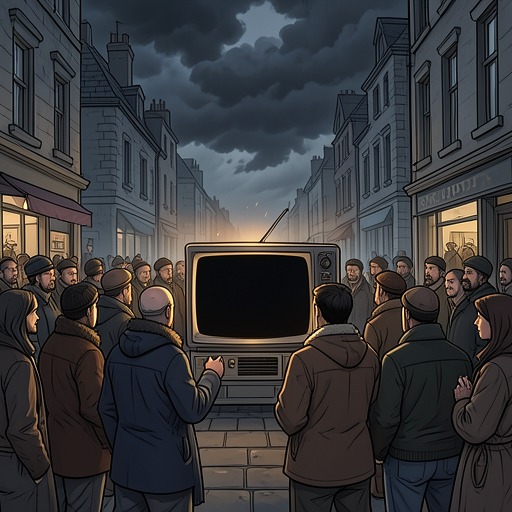
The SilenceGlobal technological systems collapse is the novel’s shift from ordinary dependence on working devices to a world in which screens, communications, and power can no longer be trusted. The failure first becomes tangible in a living room, through a television that loses sound and dissolves into patterns before going blank; later, the same loss reaches a clinic and is described as worldwide, even as warfare continues through digital and biological means. The collapse does not end conflict. It changes its instruments and makes everyday infrastructure part of the danger.
The First Visible Failures
The breakdown announces itself through an image that ceases to behave like an image. As Max Stenner and Diane Lucas watch television, the picture shakes in a way that seems to have depth. Abstract rectangles, triangles, and squares form and dissolve in a rhythmic pulse. The disturbance is not simply a blurred broadcast: its ordered, almost elementary shapes make the screen appear to be producing a new pattern rather than transmitting recognizable content.
The image gives way to silence. Max repeatedly presses the remote’s volume button, but there is no audio; then the screen goes blank. He presses the power button, switching the television on and off, without restoring it. Each familiar control remains physically available while losing its practical authority. The remote, once a transparent instrument for changing channels or volume, becomes an object that can be operated but cannot make the system respond.
Diane and Max test other devices, extending the failure beyond the television. Their phones are dead. The landline, treated as a sentimental relic, has no dial tone. The laptop is lifeless, and a computer in the next room remains gray when Diane touches its controls. The sequence matters because it moves from one failed screen to a failure across different forms of communication and computing. Max’s first calm question concerns his bet, an incongruous measure of ordinary life persisting at the instant its technical supports disappear.
The Breakdown Enters the Clinic
At the clinic, technological failure is no longer confined to a private room. Jim Kripps and Tessa Berens pass through halls marked by exit signs, blinking red lights, and notices written by hand. Staff hurry through the building in street clothes beneath their tunics, while people arriving from a van enter rooms, form lines, or wait and talk. The clinic still receives the injured, but its improvised activity takes place amid systems that no longer provide dependable coordination.
A woman at the clinic identifies the blank screen in a wall panel of devices and describes technology as having been crushed. Her account widens the crisis beyond electronics in the immediate room: she has encountered people displaced by an abandoned subway, stalled elevators, empty office buildings, and barricaded storefronts. Those are not all the same kind of failure. Together, however, they show how transport, access to buildings, workplaces, and public order have been disrupted. She refuses the role of adviser on the larger situation, explaining that the clinic is there for injured people; her uncertainty about what is happening is itself part of the scene.
The loss becomes more intimate when the clinic’s overhead lights blink, dim, and go out. The room falls into instant silence, and those waiting remain still, unsure whether the blackout is temporary or a lasting escalation. The woman responds by recounting her own history—where she was born and raised, and the names of her relatives and the institutions of her life—in a voice marked by both calm and hysteria. With the devices dark, personal memory and speech take the place of information systems, but the scene offers no assurance that testimony can explain or repair the crisis.
A War That Continues Without Nuclear Launches
The narrative later places the collapse within a larger conflict. It states that unknown groups or agencies are manipulating launch codes remotely and that nuclear weapons worldwide have become dysfunctional: missiles are not crossing oceans and bombs are not being dropped from supersonic aircraft. This does not amount to peace. The war continues, while its terms accumulate in cyberattacks, digital intrusions, biological aggression, and the deaths and disabilities associated with them.
The catalogue of threats includes anthrax, smallpox, and other pathogens, as well as starvation and plague. Power grids are also described as collapsing. The result is a sharp reversal: nuclear weapons, the familiar emblem of catastrophic modern warfare, are incapacitated, but the conflict persists through attacks on networks, biological vulnerability, and the infrastructure that sustains ordinary life. The narrative names the campaign as World War III through Martin Dekker, while its account of the conflict emphasizes that the absence of functioning missiles has not stopped its consequences.
Martin’s speech about biological weapons becomes harder for Diane to place. He recites a list of countries and then germs, genes, spores, and powders, breaking into a coughing fit before wiping his mouth and continuing. Diane recognizes that he is speaking in an adopted accent meant to sound like Albert Einstein. She cannot determine whether his account is fiction, or how he might have access to censored news. The passage therefore gives weight to the war’s reported biological dimension while preserving uncertainty about the source and reliability of Martin’s particular claims.
Screens, Silence, and Uncertainty
The scale of the shutdown is conveyed partly through questions rather than a complete inventory. Martin wonders whether all screens have emptied out and speculates about people with phones implanted in their bodies, asking how such devices might work and whether they could offer protection from global silence. These are posed as questions, not established explanations. Their importance lies in how quickly the loss of ordinary communication makes even bodily technology imaginable as a refuge—and how little anyone can verify about it.
The collapse also disturbs the distinction between a malfunction and a changed world. In the clinic, people wait to learn whether darkness is temporary; elsewhere, the narrative describes power grids failing and personal perceptions sinking into what it calls quantum dominance. Questions about rising oceans and warming air add environmental uncertainty without resolving whether the crisis is technological, natural, or both. The recurring blank screen is therefore not a diagnosis. It is a visible limit: the instruments that once delivered news and connected people can no longer confirm what is happening beyond their immediate surroundings.
Consequences and Significance
The failures expose how much everyday action depends on systems that are normally unnoticed. A phone, landline, computer, screen, or electric light appears ordinary while it works; once it fails, each becomes a separate measure of lost access, communication, or orientation. The clinic’s handwritten notices and waiting crowds show people continuing to act, but through slower, local arrangements that cannot resolve the larger emergency. Technology’s disappearance does not make human needs disappear: the injured still need care, people still seek information, and those gathered in darkness still fear what may follow.
The event’s decisive consequence is thus not a clean transition from high technology to safety. Digital and biological attacks continue as nuclear weapons fall silent, while failing grids and communications amplify uncertainty. Even the apparent cessation of one form of warfare offers no stable refuge from the others. The novel leaves the shutdown unresolved: screens remain blank, the scope of the breakdown is described in widening terms, and neither the people in the clinic nor those listening to Martin can establish what will return or what kind of conflict now surrounds them.